When urban channel banks begin to fail, roads, sidewalks, utilities, and public amenities can quickly follow. What starts as erosion along a creek, drainage channel, or stream corridor can turn into pavement damage, safety concerns, and costly infrastructure repairs if it is not addressed early.
For municipal public works leaders, land developers, and HOA property managers in North Texas, understanding urban channel bank instability is critical to protecting community assets and planning the right response before conditions worsen.
This guide explains what urban channel bank erosion is, why it threatens roads and public amenities, how to recognize early warning signs, and what stabilization options may help reduce long-term risk.
Urban Channel Bank Risks to Roads
- Urban channel bank erosion often accelerates when development increases runoff volume and flow velocity.
- Failing banks can threaten roads, sidewalks, trails, utilities, ponds, drainage features, and nearby property.
- Early warning signs may include exposed roots, leaning trees, undercut banks, pavement cracking, settlement, and sinkholes near channel edges.
- The right stabilization approach depends on site conditions, hydraulic forces, nearby infrastructure, and long-term performance goals.
- Acting early can help reduce repair costs, limit service disruptions, and prevent more extensive infrastructure damage.
What Is Urban Channel Bank Erosion?
Urban channel bank erosion is the wearing away and destabilization of the sides of a stream, creek, drainageway, or other channel caused by flowing water. In developed areas, this process often accelerates because rainfall is no longer absorbed the way it would be in more natural conditions.
As impervious surfaces such as roads, rooftops, and parking areas increase, more stormwater is directed into drainage systems and channels. During heavy rain events, those higher and faster flows can weaken the bank, scour the toe, and trigger slope movement or collapse.
Over time, an eroding channel can migrate closer to roads, utilities, sidewalks, detention features, and other built assets. What appears to be a bank maintenance issue can quickly become an infrastructure problem.
Why Urban Channel Bank Erosion Threatens Roads and Public Amenities
Roads and public amenities are often located near drainage corridors because channels naturally follow low points through a site or community. When a channel bank begins to fail, the supporting soil around nearby infrastructure may begin to move as well.
This can create a chain reaction:
- Stormwater flow erodes the lower portion of the bank.
- The upper bank loses support and begins to crack, slump, or collapse.
- The edge of the channel moves closer to nearby infrastructure.
- Soil loss beneath pavement or flatwork creates instability.
- Roads, sidewalks, trails, utilities, or other improvements begin to crack, settle, or fail.
For municipalities, HOAs, and developers, these failures can create more than repair costs. They can also lead to access problems, liability concerns, resident complaints, emergency response needs, and pressure on maintenance budgets.
Common Assets at Risk
Urban channel bank erosion can threaten a wide range of infrastructure and community features, including:
- Roads and parking areas that lose subgrade support
- Sidewalks and trails that begin to crack, settle, or tilt
- Utility corridors where water, sewer, gas, or electrical lines may become exposed
- Bridges and culverts affected by scour or bank movement
- Ponds and drainage features that lose function or experience edge instability
- Common areas and public spaces located near active erosion
- Homes, lots, and adjacent property improvements where failure progresses beyond the channel edge
What Causes Urban Channel Banks to Fail?
Urban channel bank instability is usually not caused by one factor alone. In many cases, failure develops because several conditions combine over time.
Common contributors include:
- Increased runoff from upstream development
- Concentrated stormwater discharge
- Frequent high-flow events
- Toe erosion along the lower bank
- Poor or sparse vegetation
- Weak or highly erodible soils
- Drainage patterns altered by nearby construction
- Infrastructure interactions, including utilities or crossings
- Previous repairs that treated symptoms but not root causes
That is why effective stabilization starts with understanding the reason for erosion or failure, not just the visible damage.
Early Warning Signs of Urban Channel Bank Instability
One of the best ways to reduce repair costs is to identify instability before the channel reaches a road, utility, or community amenity.
Vegetation Warning Signs
Vegetation often reveals early erosion activity before larger failures occur.
Look for:
- Exposed root systems along the bank face
- Trees leaning toward the channel
- Trees or brush falling into the creek or drainageway
- Sudden bare areas where vegetation has been lost
- Thin or weak plant cover on steep sections of bank
Bank Condition Warning Signs
Changes in the shape of the bank can indicate active movement or loss of support.
Watch for:
- Undercut banks
- Overhanging sections of soil
- Fresh sloughing or slumping
- Tension cracks running parallel to the channel edge
- Steep, unstable slopes with little vegetative cover
- Areas where erosion appears to be moving upstream or downstream
Infrastructure Warning Signs
Sometimes the first visible clues appear in the improvements near the channel rather than in the bank itself.
Look for:
- Cracks in pavement near the channel
- Settling sidewalks or trails
- Depressions near the bank edge
- Sinkholes or voids
- Exposed utilities
- Movement around culverts, inlets, or crossings
If these signs are present, the issue may already be affecting infrastructure performance and should be evaluated promptly.
How to Assess Channel Bank Risk Near Roads and Amenities
A practical field assessment can help determine whether erosion is a low-priority maintenance issue or a growing threat to infrastructure.
1. Document Existing Conditions
Walk the affected reach and photograph visible signs of erosion, slope movement, drainage patterns, and nearby asset exposure. Identify where the most active areas appear to be concentrated.
2. Measure Proximity to Assets
Note how close active erosion is to roads, sidewalks, trails, utilities, walls, ponds, or other improvements. The closer erosion is to critical infrastructure, the less margin for delay.
3. Evaluate Bank Geometry and Soil Conditions
Steeper banks and loose or highly erodible soils often fail more easily than gradual, well-vegetated slopes. Areas showing undercutting or repeated slumping deserve closer attention.
4. Review Upstream Influences
Recent development, added impervious cover, drainage changes, or altered discharge points upstream may help explain why a previously stable channel is now failing.
5. Consider Consequences of Failure
Not every erosion problem carries the same operational risk. A failing bank near a heavily used road, utility corridor, or public space typically demands more urgent attention than one in a lower-consequence area.
Stabilization Options for Urban Channel Banks
Once the cause and extent of channel bank failure have been evaluated, the right stabilization strategy depends on site conditions, hydraulic forces, surrounding infrastructure, and long-term performance goals. In many cases, the most effective solution is a combination of structural and non-structural methods designed to create a stable, long-lasting, and more natural result.
Biotechnical and Vegetated Stabilization Methods
Restoration-minded approaches can combine native plants with engineered stabilization systems to improve bank integrity and support long-term performance. Depending on site conditions, this may include soft armor applications, vegetated stabilization, native planting, and live staking.
These methods can help restore stability while supporting a more natural appearance and minimizing impact on the surrounding environment.
Structural Stabilization Methods
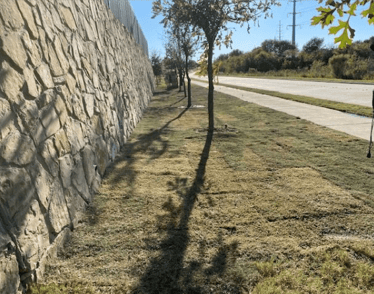
Where erosion is more severe or site constraints limit vegetated solutions, structural reinforcement may be needed. Urban channel bank stabilization may involve plate piling, turf reinforcement, retaining wall systems, geoweb systems, and reinforced earth solutions.
These methods are often used where active failure threatens roads, utilities, drainage systems, trails, crossings, or other nearby infrastructure.
Integrated Solutions for Long-Term Stability
In many cases, the best result comes from combining structural stabilization with environmentally responsible restoration methods. Structural reinforcement may address severe erosion and high-flow forces, while vegetated approaches can support long-term resilience and a more natural-looking finished condition.
When to Engage Professional Engineering and Construction Support
Some channel erosion issues can be monitored for a period of time. Others require prompt professional evaluation because the consequences of failure are too significant.
It may be time to engage professional support when:
- Erosion is moving toward a road, sidewalk, trail, or utility corridor
- The bank shows active slumping, undercutting, or repeated collapse
- Upstream development or drainage changes appear to be increasing flows
- A previous repair has not held
- The site includes culverts, crossings, ponds, or other structural constraints
- Permitting, floodplain, or jurisdictional questions may affect the work
- You need a practical path from investigation to construction
In these situations, a site-specific assessment is important because the visible erosion may be only part of the problem.
Why Design-Build Matters for Channel Stabilization
Urban channel bank failures are rarely solved well by disconnected handoffs. Stabilization often involves drainage behavior, erosion mechanisms, constructability, access constraints, and long-term maintenance considerations all at once.
A design-build approach helps align those factors earlier in the process. When engineering and construction teams collaborate closely, solutions can be shaped around both site conditions and real-world implementation.
For municipalities, developers, and community managers, this can mean:
- fewer handoff issues,
- better coordination,
- clearer scope development,
- and a more practical path from investigation to execution.
Permitting and Regulatory Considerations
Channel stabilization projects may require coordination with local, state, or federal agencies depending on the site and scope of work.
Common considerations may include:
- municipal drainage or stormwater approvals,
- floodplain development requirements,
- utility coordination,
- erosion and sediment control measures,
- and potential state or federal review for work affecting regulated waters.
Because permitting requirements vary by location and project type, it is best to identify those needs early rather than after design decisions have already been made.
The Cost of Waiting
Urban channel erosion rarely corrects itself. As storm events continue, the forces acting on the bank continue as well.
Delaying action can increase costs by allowing:
- erosion to move closer to infrastructure,
- repair quantities to expand,
- emergency conditions to develop,
- and access, traffic control, or utility complications to become part of the project.
Early action does not always mean immediate construction, but it does mean understanding the risk before a manageable repair becomes a more disruptive and expensive one.
How Cardinal Strategies Approaches Urban Channel Bank Stabilization
Cardinal Strategies helps communities and property stakeholders identify the reason for erosion or failure and develop long-term solutions built around site conditions, infrastructure risk, and environmental considerations.
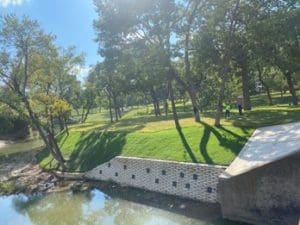
For urban channel bank stabilization and stream channel restoration bioremediation, Cardinal uses a biotechnical remediation approach that may combine man-made products such as plate piling, turf reinforcement, and retaining wall systems with native plants to create a long-lasting, stable, and more natural solution
Cardinal also emphasizes the importance of addressing root causes rather than relying on surface-level fixes alone. In North Texas, where development pressure and stormwater impacts can change channel behavior over time, that practical, integrated approach matters
What to Do If You See Channel Erosion Near a Road or Amenity
If you are seeing signs of channel instability near community infrastructure, a good next step is to document the condition and have the site evaluated before the problem escalates.
That may include:
- photographing active erosion areas,
- identifying nearby at-risk assets,
- noting any recent changes in drainage or upstream development,
- and scheduling a professional site investigation to determine likely causes and repair options.
The earlier the issue is understood, the more options are typically available.
Conclusion
Urban channel bank erosion can threaten much more than the edge of a creek or drainage corridor. Left unaddressed, it can affect roads, sidewalks, utilities, trails, ponds, public spaces, and the long-term resilience of the surrounding property.
For municipal teams, land developers, and HOA leaders in North Texas, the most effective response starts with recognizing the warning signs, understanding the risks to nearby infrastructure, and evaluating the right stabilization approach before failure spreads.
When the stakes include public safety, access, community amenities, and infrastructure budgets, early investigation is often the smartest investment.
FAQs About Urban Channel Bank Risks to Roads
How quickly can channel bank erosion damage roads?
That depends on site conditions, soil type, storm intensity, bank geometry, and how close the erosion is to the road. In some cases, deterioration happens gradually over time. In others, a major rain event can accelerate failure much faster than expected.
What causes urban channel banks to fail faster than more natural channels?
Urban development increases impervious cover and often sends more runoff into drainage systems and channels at higher flow rates. Those changes can place greater erosive stress on the bank than the channel historically experienced.
What are the first warning signs to look for?
Common early signs include exposed roots, leaning trees, undercut banks, tension cracks, slumping soil, pavement cracks near the channel, settlement, and sinkholes near the bank edge.
Do all failing channel banks need structural stabilization?
No. The right solution depends on the site. Some areas may benefit from vegetated or biotechnical stabilization, while others need structural reinforcement because of erosion severity, hydraulic forces, or limited space.
When should a municipality or HOA call a professional?
Professional evaluation is a good idea when erosion is moving toward roads, sidewalks, utilities, drainage features, or other community assets, or when the bank shows active instability after storm events.
What makes a design-build approach helpful?
Design-build can improve coordination between assessment, planning, and construction. For complex erosion problems, that often leads to a more practical and efficient path to stabilization.
How much does urban channel bank stabilization cost?
Costs vary based on bank length, access, soil conditions, severity of erosion, nearby infrastructure, and the type of stabilization required. Site-specific investigation is usually needed before a meaningful cost range can be developed.
How long do stabilization solutions last?
Longevity depends on design, installation quality, hydraulic conditions, maintenance, and whether the solution addresses the real cause of erosion. Well-planned stabilization is intended to provide long-term performance, not just a temporary patch.