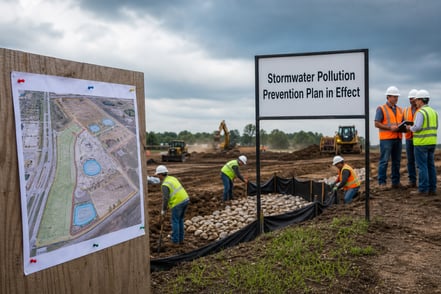
What Texas Construction Leaders Must Know About Stormwater Regulations
Stormwater compliance for construction means controlling how rainwater runs off disturbed soil so it does not carry sediment and pollutants into nearby waters. In Texas and Oklahoma, that typically requires coverage under a state general permit, a written SWPPP/SWP3, and consistent inspection and documentation throughout the project.
If your project disturbs one acre or more of soil, or is part of a larger common plan of development, you are most likely subject to construction stormwater permitting. In Texas, the Texas Commission on Environmental Quality (TCEQ) regulates this under the Construction General Permit TXR150000, renewed in 2023. In Oklahoma, the Department of Environmental Quality (ODEQ) oversees construction stormwater under General Permit OKR10.
These permits outline who must obtain coverage, how to develop and implement a Stormwater Pollution Prevention Plan (SWPPP or SWP3), inspection frequencies, stabilization timelines, and recordkeeping. For example, TCEQ’s 2023 Construction General Permit clarifies site notice requirements and electronic submittals through the STEERS system, while ODEQ’s OKR10 sets specific timelines for temporary and final stabilization.
A common pain point for superintendents and project managers is that stormwater requirements feel like a moving target, especially when projects cross city limits or state lines. Local ordinances, drainage criteria manuals, and floodplain regulations can all layer on top of state and federal rules. Missing a single requirement can trigger stop-work orders or rework that ripples through your schedule.
The key is to treat stormwater compliance as a core part of project planning, not a box to check when construction is already underway. Understanding permit thresholds, operator responsibilities, and documentation expectations early allows you to budget correctly, phase work smartly, and avoid surprises when the inspector shows up after a major rain.
How To Build a Compliant Site From Day One and Avoid Project Delays
To keep your project on schedule under stormwater regulations, design compliance into the job from day one. That means scoping the right permit coverage, developing a practical SWPPP, phasing earthwork intelligently, and scheduling inspections as tightly as you schedule concrete pours or deliveries.
Start with a permit threshold check in preconstruction. Estimate the total disturbed area, including staging areas, stockpiles, and access roads. If you are near the one‑acre threshold, assume you will need permit coverage and build that into your schedule and budget. In Texas, this often means filing a Notice of Intent (NOI) through the TCEQ STEERS system and posting the correct site notices; in Oklahoma, you’ll follow ODEQ’s OKR10 procedures.
Next, insist on a SWPPP that is both compliant and buildable. A practical plan translates regulatory language into clear site maps, control locations, maintenance expectations, and inspection checklists your crews can actually use. For example, instead of generic notes about “install perimeter controls,” your plan should show where silt fence is required, where rock check dams will go, and how frequently inlets must be protected as paving progresses.
Sequencing can make or break both compliance and schedule. Phasing earthwork to limit how much soil is exposed at once reduces the size and cost of temporary controls and makes it easier to stabilize disturbed areas quickly. ODEQ’s construction stormwater guidance emphasizes timely stabilization. Getting seed, mulch, or pavement down promptly reduces both erosion and the risk of permit violations.
Inspection and documentation are your front line against delays. Set a recurring inspection cadence that meets or exceeds permit requirements, often every 7–14 days and after significant rain events and assign clear responsibility. Many project teams use a standard field checklist that captures conditions, deficiencies, corrective actions, and photos. When an inspector visits, having organized records and documented corrective actions shows good faith and can prevent minor issues from escalating.
Finally, educate your crews. A 10‑minute toolbox talk before key phases, mass grading, utility installation, and paving, reinforces why certain controls must stay in place, what not to disturb, and who to call if a storm damages protections. Many delays stem from simple misunderstandings, such as equipment operators removing controls for access and not reinstalling them before rain.
When to Bring in Stormwater Compliance Experts to Protect Your Schedule
Stormwater compliance experts help construction teams interpret regulations, design workable controls, and respond quickly when conditions change. Bringing them in early rather than after a warning letter reduces rework, protects your relationships with regulators, and keeps your crews focused on building.
Specialists who focus on construction stormwater live in the intersection of engineering, environmental regulations, and field operations. They understand TCEQ and ODEQ permit language, but they also know how a job site actually runs. For example, they can recommend control layouts that accommodate haul routes and staging areas, rather than forcing you to move controls repeatedly as the project evolves.
On many sites, third‑party inspectors or compliance partners conduct routine inspections, document conditions, and flag issues before they become violations. This outside perspective can be especially valuable for busy project managers juggling schedules, subs, and client demands. A dedicated stormwater partner can track inspection frequencies, rainfall events, and stabilization deadlines so your team doesn’t have to.
Experts also add value when plans need to change quickly. After a large storm, new drainage patterns might appear, or existing controls may fail. An experienced team can assess damage, revise the SWPPP, and design reinforced measures that both meet regulatory expectations and match your construction sequence. This agility can be the difference between a short cleanup and a prolonged shutdown.
When projects fall under multiple jurisdictions, such as a site in North Texas with local post‑construction requirements plus state permit coverage, the regulatory maze can be daunting. Compliance-focused consultants are used to coordinating with municipal staff, reviewing local criteria manuals, and aligning your site practices with both local and state expectations.
Finally, partnering with a firm that offers both regulatory navigation and field services simplifies your workflow. Instead of managing separate vendors for SWPPP development, inspections, and corrective work, you gain a single, accountable partner who understands your schedule, your risk tolerance, and your long‑term development plans.
If you are ready to reduce regulatory uncertainty, protect your timelines, and strengthen your compliance program, consider working with a stormwater specialist who understands construction in North Texas and southern Oklahoma and can guide you from permitting through final stabilization.
.png?width=300&height=300&name=Untitled%20design%20(30).png)